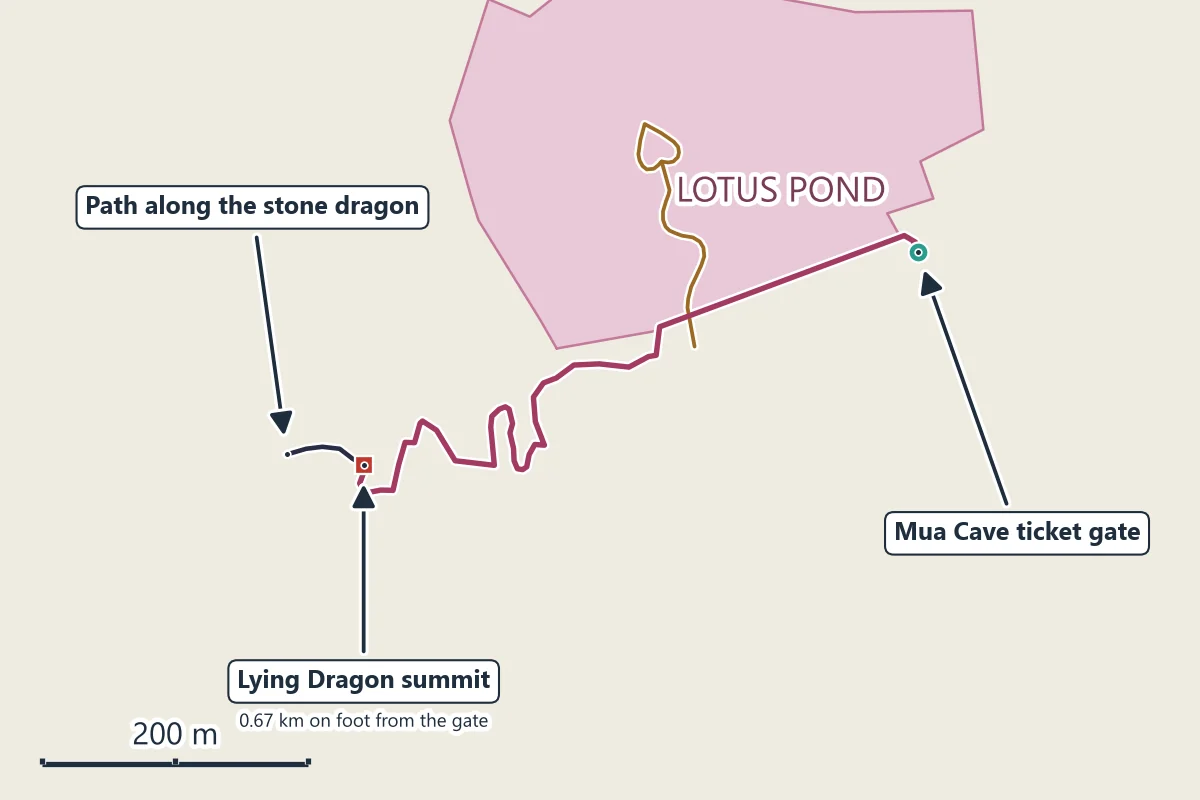
The stairway is the reason most people come. From the ticket gate a path runs along the lotus pond to the foot of the hill, and from there white stone steps climb the ridge of Ngoa Long in tight switchbacks to the summit. On either side the balustrades are carved with dragons and phoenixes, which Ninh Binh’s tourism promotion centre describes as worked in the manner of Tran-period art.
How many steps
| Source | Count |
|---|---|
| Ninh Binh tourism promotion centre, Vietnamese page on the Hang Mua tourist area | 486 steps |
| The same centre, English page on Mua Cave | nearly 500 steps |
| Press reports of the operator’s 2026 ticket notice | about 500 steps |
The centre belongs to Ninh Binh’s tourism department, and its two pages disagree with each other; neither says where the count starts. The operator, Lac Hong Trading and Tourism Company, has no website of its own that we could find. The safe answer is just under 500.
The route and the distance
| From | To | On foot |
|---|---|---|
| Mua Cave ticket gate | Lying Dragon summit | 0.67 km |
Routed along the mapped paths and stairs between the two points named. The first part is level: a path along the edge of the lotus pond. Then the climbing starts, and it does not stop until the top.
Near the top the stairway divides. One branch ends at the summit platform; the stone dragon runs along the ridge just to the west of it. The summit page describes what is up there.
How long it takes
No managing body publishes a climbing time. The distance is short; the steps are steep, and the time you need is mostly the time you rest. Allow for the climb, time at the top for the view, and a slower descent: going down steep stone steps takes care, especially when they are wet. If you are climbing for the sunset, leave yourself enough light to come down (see sunrise and sunset).
How hard it is
The climb is a stair, not a hike: no scrambling on the main route, no navigation. What makes it hard is the gradient and, from May to September, the heat. Ninh Binh’s long-term averages are 27.3°C in May, 29.0°C in June and 29.2°C in July, and the stairway is in the open. In December and January the averages are 18.3°C and 16.6°C, and a cooler day makes the steps easy work.
What to bring
- Water, at least half a litre each, more in summer.
- Shoes with grip. Stone steps are slippery after rain, and the way down is where people slip.
- A hat from May to September.
- A torch if you stay for the sunset.
- Dong in cash for the ticket: 150,000 dong for anyone over 1 m tall (checked November 2026). See ticket and opening times.
Safety on the stairway
- Climb at your own pace and stop on the landings, out of the way of people coming down.
- Hold the balustrade on the way down.
- Keep children beside you, on the steps and at the summit.
- Keep to the steps and the platforms. The rock beside them is rough limestone.
- Turn back in a thunderstorm: the summit is the highest point around.